Ports · Micro-tunnel
Micro-tunnel pit, Pipavav
A micro tunnel was being driven about 60 m from the sea line through saturated sandy silt when a crack in the wall let seawater in at 200 to 350 litres per minute. Repeated attempts to seal it had failed under the water pressure. Chemical grouting through self-drilling anchors sealed up to 85 per cent of the ingress, as the client’s certificate records.
- Completed
- 2013
- Location
- Pipavav, Gujarat, about 60 m from the sea line
- Type
- Micro-tunnel pit
- Client
- Coastal Marine Construction & Engineering (COMACOE)
CertifiedCompletion certificate dated 22 April 2013: water ingress sealed up to 85 per cent, and the work completed in the given time.
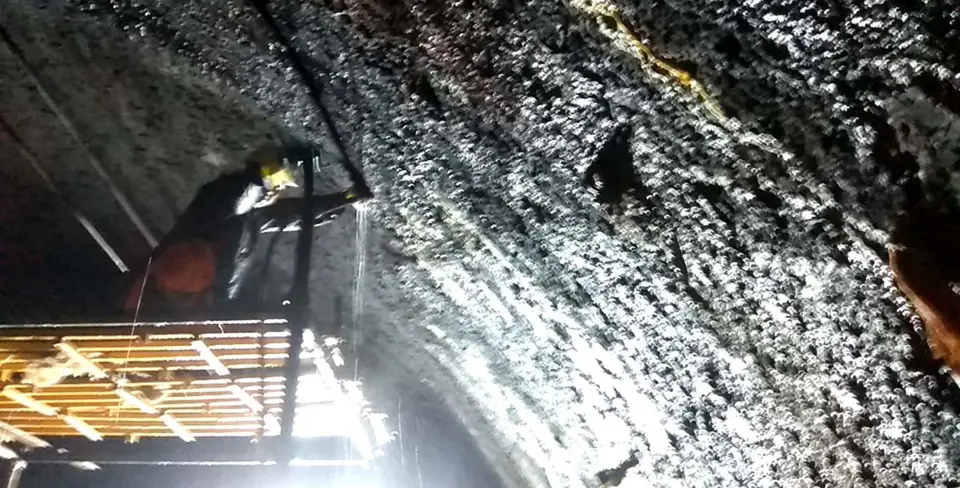
Seawater inflow through the crack before treatment.
Water ingress sealed, as recorded on the client’s completion certificate.
Work completed in the given time and certified.
- Water ingress sealed up to 85 per cent.
- Work completed in the given time; completion certificate issued in April 2013.
The problem
Seawater under pressure, through a crack
The micro tunnel was being excavated by a micro boring machine through stiff sandy silt, saturated and under the sea’s water head. When a crack opened in the wall, seawater came in at 200 to 350 litres per minute and stopped the work. Earlier attempts to seal the crack had failed against the groundwater pressure.
What we did
Grout around the crack, from inside the pit
- Self-drilling anchors installed through the wall into the ground around the crack.
- Chemical grout injected through them to cut off the water and bind the ground.
- 1Note 1: Micro-tunnel pit, about 60 m from the sea line.
- 2Note 2: Stiff sandy silt, saturated, under the sea’s water head.
- 3Note 3: A crack in the pit wall let seawater in at 200 to 350 litres per minute.
- 4Note 4: Self-drilling anchors and chemical grout injected around the crack.
- 5Note 5: Inflow controlled and the work completed; completion certificate issued in April 2013.
Services on this job
Methods used
Tunnel water ingress control
Leaks and inflow stopped in tunnels, shafts and underground structures.
Rock bolting and self-drilling anchors
Rock bolts, self-drilling and prestressed anchors for tunnels, portals, slopes and caverns.
Permeation and chemical grouting
Weak, loose or wet ground strengthened and sealed by resins and gels that fill it without moving it.
CertifiedCompletion certificate dated 22 April 2013: water ingress sealed up to 85 per cent, and the work completed in the given time.
More projects
Similar work
Parsik tunnel, Thane–Kalyan
Seepage controlled in a brick-lined railway tunnel built in 1916, on a busy main line, without stopping the trains.
USBRL tunnels T-1, T-3 and T-5, Katra
Heavy water ingress in Himalayan tunnels, controlled with our resin, grout design and crews: recorded by Northern Railway at up to 2,500 litres per minute.
T-49B escape tunnel, Arpinchala, USBRL
Cavities in a Himalayan escape tunnel treated with low-foaming and water-reactive PU resins: one of the two largest chemical grouting jobs we have held.
A similar problem on your site?
An engineer reviews it and replies with the next step. The client documents behind this project are sent on request.