Water
Tunnel water ingress control
Water through a tunnel lining corrodes fixings, softens the ground behind it and, in cold sections, turns to ice. We find where it comes from, choose the resin for the flow and the ground, and inject it from inside the tunnel while the tunnel stays in use.
When to call us
The signs
- Drips and damp patches through cracks and construction joints in the lining.
- Running leaks at segment joints, cold joints and old repairs.
- Heavy inflow through fractured rock during excavation, including inflow under high head.
- Water behind the lining carrying fines out of the ground.
- Shafts and adits taking water from a water-bearing layer.
- 1Note 1: Water-bearing joints and fractures in the rock around the tunnel.
- 2Note 2: Leaks through cracks and construction joints in the lining.
- 3Note 3: Holes drilled through the lining into the rock, in a pattern set by the leak map.
- 4Note 4: A packer seals each hole, so the resin goes into the ground and not back into the tunnel.
- 5Note 5: Water-reactive PU (DrucHyd 2C) expands on contact with water and fills joints and voids behind the lining.
- 6Note 6: The treated ring cuts the water off before it reaches the lining.
- 7Note 7: Inflow is mapped and measured before treatment, and measured again after it.
How we do it
Method, step by step
Map the leaks
Every leak surveyed by type and flow, inflow measured where it can be, and the lining and the ground behind it checked.
Choose the resin
Water-reactive PU for running water and high flow; hydrophobic or hydrophilic PU and acrylate gels for wet, moving cracks; microfine cement where a cementitious grout is specified.
Drill and set packers
Holes drilled through the lining in a pattern set by the leak map, each one sealed with a packer.
Inject in sequence
From the lowest point upwards and from the edge of a leak zone inwards, with pressure and volume logged for each hole.
Verify
Inflow measured again and the leaks re-surveyed against the acceptance value agreed before work started.
What we use
Made at our plant in Alwar
DrucHyd 2C (aqueonglobal.com, opens in a new tab)
Curtain grouting against active inflow; waterproofing and consolidation under water pressure.
PuTeRA (aqueonglobal.com, opens in a new tab)
Water stopping, void filling, ground reinforcement, slab and track lifting.
Teracryl (aqueonglobal.com, opens in a new tab)
Fine soils, and wet, fine cracks.
GeoFine (aqueonglobal.com, opens in a new tab)
Rock and soil injection where a cementitious grout is specified.
Quality
Checks and proof
- Batch check on delivery, and a cup test at the start of each shift to set the gel time for the day’s temperature.
- Pressure and volume logged for every hole, with refusal criteria set before work starts.
- Inflow measured before and after, against an acceptance value agreed with the client.
On record
Where we have done it
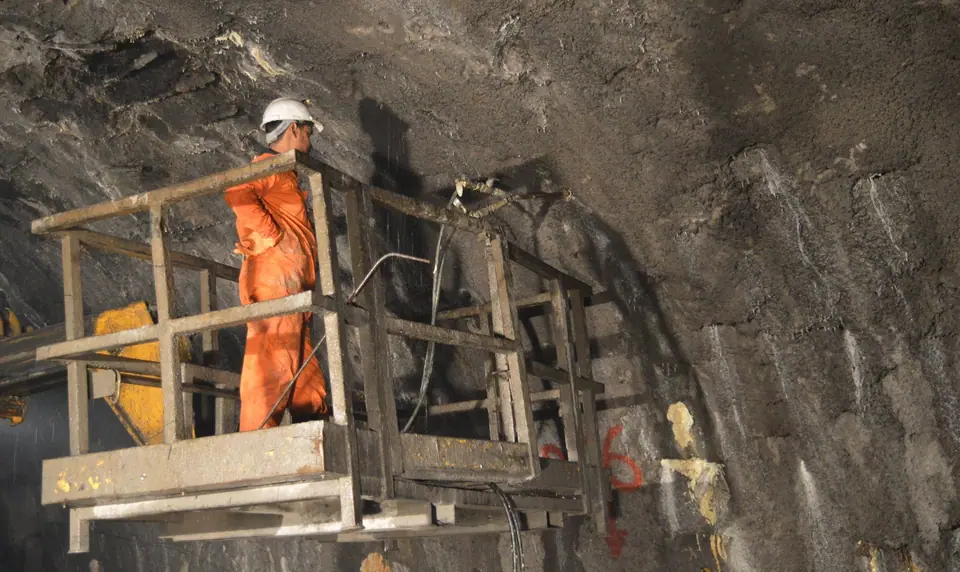
USBRL tunnels T-1, T-3 and T-5, Katra
Heavy water ingress in Himalayan tunnels, controlled with our resin, grout design and crews: recorded by Northern Railway at up to 2,500 litres per minute.
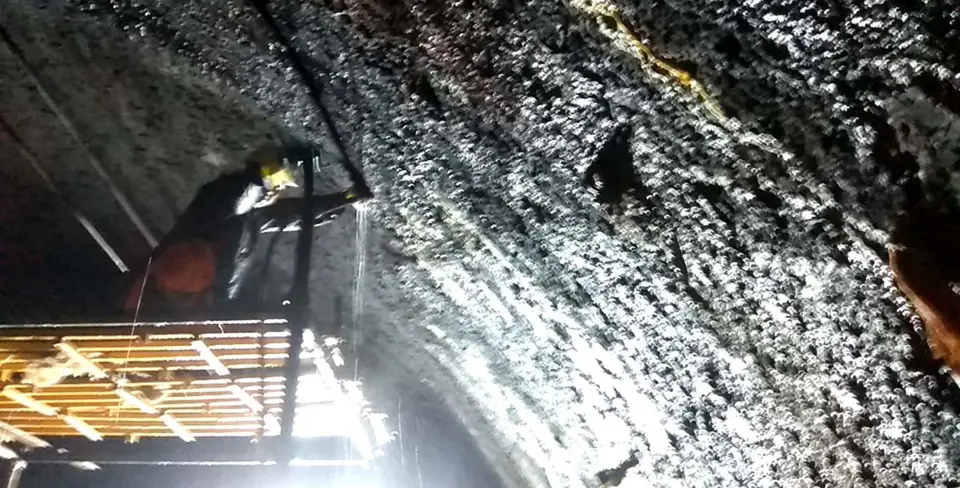
Parsik tunnel, Thane–Kalyan
Seepage controlled in a brick-lined railway tunnel built in 1916, on a busy main line, without stopping the trains.
Micro-tunnel pit, Pipavav
Seawater pouring into a micro-tunnel pit through a crack, after repeated attempts to seal it had failed. Sealed up to 85 per cent by grouting.
Delhi Metro CC-04, Azadpur
Two tunnel boring machines held 30 m down in loose, saturated sand. We sealed and consolidated the ground so they could be retrieved.
Questions
What clients ask
Can you control water in a tunnel that is in use?
Yes. The work is done from inside the tunnel, in the gaps the operator can give, and the lining is drilled only where the leak map shows it is needed. In the Parsik tunnel, on a busy main line, the seepage was brought under control while trains kept running.
Which resin do you use for running water?
For active flow, a water-reactive polyurethane: it expands when it meets water and sets fast enough not to be washed out. For damp, fine cracks, a hydrophilic PU or an acrylate gel can be the better choice. We decide after seeing the leak, not before.
How do you know the treatment worked?
We measure inflow before and after, and agree the acceptance value with you before work starts. Grout take on its own tells you what went into the ground, not what was achieved.
How much water can be controlled?
It depends on the ground, the water head and the access. In a 2016 letter, Northern Railway’s USBRL project office recorded that our grout design and application had controlled heavy seepage of up to 2,500 litres per minute inside the tunnels.
Related services
Often used together
Pre- and post-excavation grouting
Water cut off and weak ground consolidated ahead of the face; voids closed behind it.
Tunnel rehabilitation
Old and operating tunnels: seepage stopped, ground consolidated and lining repaired, under traffic.
Crack and joint injection
Leaking cracks and joints sealed, and structural cracks bonded, in concrete and masonry.
Cavity and void filling
Voids above tunnel crowns, behind linings and under slabs filled without loading the support.
Seeing this on your site?
Send us what you see, where, and the access or traffic window. An engineer reviews it and replies with the next step.